Allergy Card Builder: Translated Allergy Cards in 40 Languages

Your card in minutes, no account needed

  1. 1 Select allergens
  2. 2 Pick destination
  3. 3 Download
  4. 4 Show at restaurants
1
What should restaurants know? 0
Tap everything that applies, allergens, intolerances, dietary restrictions
⚕️ Allergens and restrictions (may cause anaphylaxis)
Presets
Restrictions (dietary, religious & medical)
⚠ You've added 4 allergens, the free card supports up to 3.
2
Languages
Set the language you read and the language the restaurant sees
Destination language
My language (optional)
Pick a destination to see what hidden allergens to watch out for.

Each pass covers 1 destination language. Need a different pair? Create a new pass.

Live Preview
Example card, select your allergens above to personalise

Get your travel-ready card package

Enter your email and we'll send a high-quality image, plus Apple & Google Wallet passes, ready to show offline, no internet needed at the restaurant.

✓ Sent! Check for your card.

✓ Your image and wallet links were sent to your email after purchase.

How to use it: Show the card to kitchen staff when you order. Save it to your camera roll so you can show it without needing a connection. For severe allergies, always carry your medication, the card is a communication tool, not a substitute.
+ Add personal details (optional)
Your name and emergency contact, printed on the card
🔒 Stored only on this device, never sent to a server.
Questions

Frequently asked questions

Thai and English cards are completely free with up to 3 allergens. No sign-up, no credit card. The Single Trip pass ($4.99 one-time) unlocks any one destination language with unlimited allergens, image, and Apple Wallet export. For frequent travelers, All Access ($7.99/mo or $39.99/yr) unlocks all 40 languages. The Founder Pass ($79.99 one-time) gives permanent lifetime access to everything.
40 languages: Thai, Japanese, Vietnamese, Korean, Indonesian (Bahasa), Malay, Burmese, Sinhala, Arabic, French, German, Spanish, Portuguese, Italian, Greek, Turkish, Simplified Chinese, Traditional Chinese, Russian, Hindi, Hebrew, Dutch, Urdu, Amharic, Bulgarian, Bengali, Hungarian, Nepali, Romanian, Serbian, Swahili, Khmer, Lao, Tagalog, Czech, Polish, Ukrainian, Yoruba, Afrikaans, and English. Thai and English are free. All others are premium.
Show it to the waiter or kitchen staff on your phone screen, or hand them a printed copy. Save your card to your camera roll before you travel, you won't need an internet connection to show it.
AllergyPass cards are translated by a team with food allergy expertise and reviewed for accuracy in each destination language. However, no card is a substitute for speaking directly with staff or carrying your prescribed emergency medication.
Yes. Use the Print button on the free card, or upgrade to premium for a high-resolution image that prints cleanly. Many travellers print a wallet-sized card to keep alongside their passport.
Premium cards can be saved to Apple Wallet or Google Wallet, making your allergy card accessible directly from your phone's lock screen, no need to open the app. Apple and Google Wallet passes use a fixed layout with limited space, so Wallet cards are capped at 3 allergens, that's a limitation of the Wallet format itself, not a restriction from AllergyPass. If you have more than 3 allergens, download your card as an image instead, which has no allergen limit.
All Access is a subscription ($7.99/month or $39.99/year) that unlocks all 31 destination languages with unlimited allergens, unlimited Allergy Risk Checker, and all export formats. Cancel anytime.
No. The pack is designed for one traveler with one allergy profile traveling to multiple destinations. Each card uses the same allergen selection, translated into a different destination language.
Any destination currently supported by AllergyPass, all 40 languages including Thai, Japanese, Vietnamese, Korean, Indonesian, Malay, Burmese, Sinhala, Arabic, French, German, Spanish, Portuguese, Italian, Greek, Turkish, Simplified Chinese, Traditional Chinese, Russian, Hindi, Hebrew, Dutch, Urdu, Amharic, Bulgarian, Bengali, Hungarian, Nepali, Romanian, Serbian, Swahili, Khmer, Lao, Tagalog, Czech, Polish, Ukrainian, Yoruba, Afrikaans, and English.
Travel safety

Why allergy cards matter abroad

Language barriers make food allergies genuinely dangerous. A card removes the ambiguity.

🌏

Translation apps lose the urgency

"I'm allergic to peanuts" in Google Translate reads like a preference. A card with medical framing (in the kitchen's language) doesn't.

🫙

Hidden ingredients are everywhere

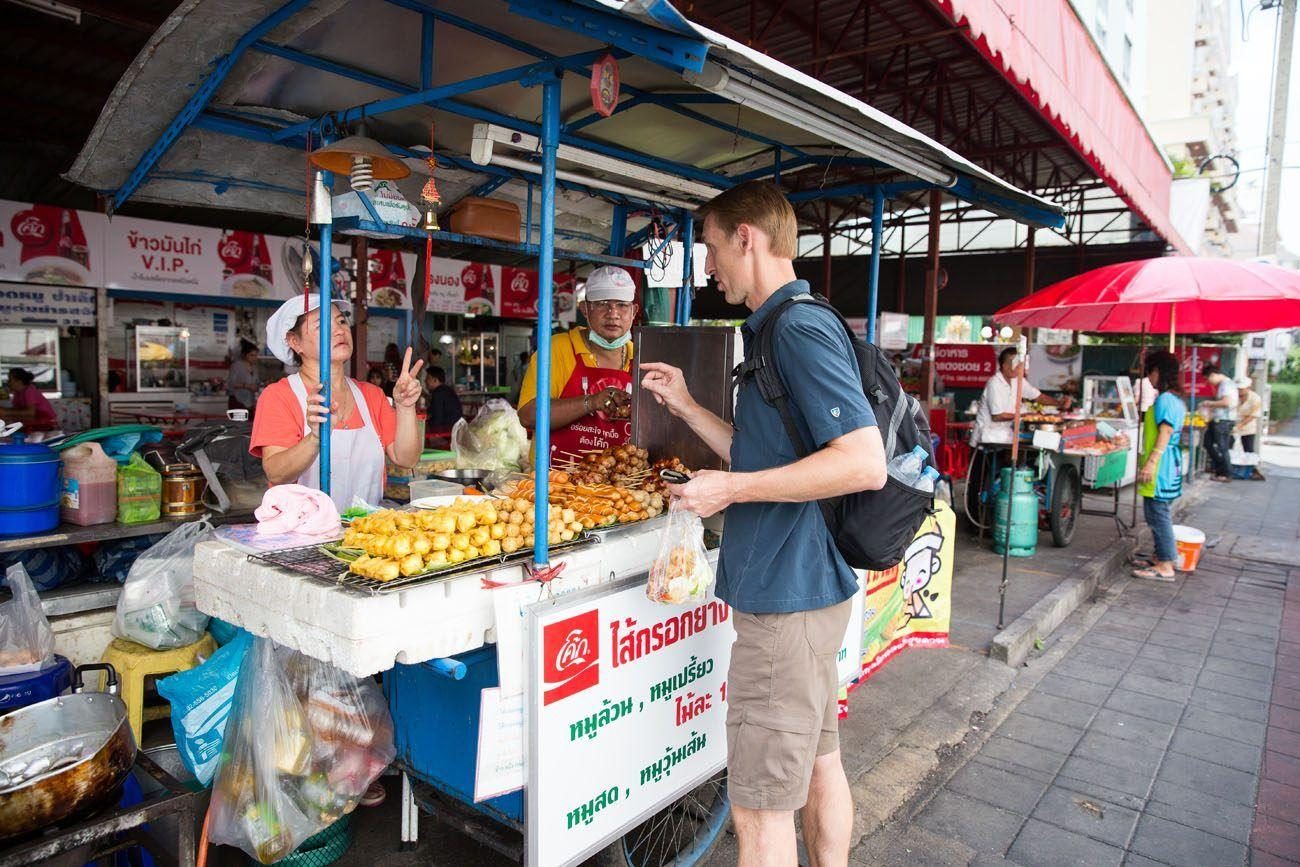
In Southeast Asia, fish sauce, shrimp paste, and peanut oil show up in dishes that don't mention them. Even experienced cooks don't always flag it.

🏥

Emergencies are stressful enough

If something goes wrong, a card in the local language helps first responders act faster. Worth having and never needing.

Important: A card is a communication tool, not a medical guarantee. Always carry your prescribed emergency medication, and always tell staff verbally as well as showing the card.
Expert advice

Communicating allergies abroad

A bilingual card is your most reliable tool. But it works best alongside a few habits.

Before you travel

Learn the cuisine. Southeast Asian cooking uses fish sauce and shrimp paste as base flavours, they're in dishes that don't mention them on the menu. Know what you're walking into before you land.

At the restaurant

Show the card and say it out loud. Not everyone reads well, and not everyone takes a card as seriously as a spoken request. When in doubt, order something simple you can verify visually.

What trips people up

Relying on a translation app alone. Assuming things are labelled. Skipping the verbal conversation. Leaving their medication in the hotel room.

Hidden allergens by cuisine

Thai food

Fish sauce, shrimp paste, peanuts in nearly every sauce. Pad thai base contains both fish sauce and shrimp paste.

Japanese food

Soy sauce in virtually everything. Dashi (fish stock) as base for miso soup, noodle broths, and sauces.

Vietnamese food

Fish sauce (nước mắm) as universal condiment. Peanuts in satay garnishes, phở toppings, and noodle dishes.

Indonesian food

Peanut sauce in satay and gado-gado. Shrimp paste (terasi) as the base of most sambals.

Read full travel guides →
Still thinking?

Your card is free to build

No account. No commitment. Takes 2 minutes, and you can always save it later.